
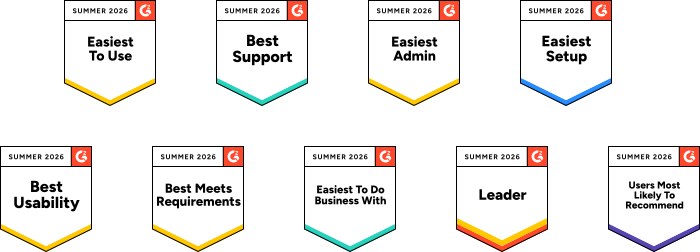
G2 Summer 2026 · 95 No-Code and Low-Code development platforms

Best No-Code and Low-Code platforms in 2026: A comparative analysis based on G2 report data.

AuraQuantic leads the G2 Summer 2026 Usability Index for Rapid Application Development (RAD) Software, achieving a 94% usability score and ranking No. 1 among 95 No-Code and Low-Code platforms. It also records an 84% user adoption rate in the same index. In the G2 Summer 2026 Results Index for Digital Process Automation (DPA) Software, AuraQuantic ranks first with an 88% business outcomes score among 29 platforms and achieves an ROI of 6.68 months.

This comparison analyses AuraQuantic against Appian, Bizagi, Creatio, Kissflow, and Nintex across four benchmark indicators: usability, time to return on investment (ROI), user adoption, and business outcomes impact. The data is drawn from two independent G2 indexes: the G2 Summer 2026 Usability Index for Rapid Application Development (RAD) Software and the G2 Summer 2026 Results Index for Digital Process Automation (DPA) Software, both based on verified reviews from real users.

No-code platforms enable business teams, such as Finance, HR, Operations, and Legal, to design applications and automate processes without writing code and without relying on IT departments. Unlike Low-Code platforms, No-Code solutions require no technical profiles for either development or management, reducing IT dependency and accelerating delivery timelines.

Are you evaluating No-Code or Low-Code platforms for your organization? This comparison brings together the most relevant market data to support a well-informed decision.

95 evaluated platforms · Data verified by real users

What G2 data reveals about AuraQuantic compared to other No-Code / Low-Code platforms.

AuraQuantic records the highest scores in the indicators that organizations prioritize when evaluating No-Code and Low-Code platforms. The following category-based results are drawn from the G2 Summer 2026 RAD Usability Index and the G2 Summer 2026 DPA Results Index.

Leader in usability among No-Code and Low-Code platforms

AuraQuantic achieves a 94% usability score among the 95 platforms evaluated in the G2 RAD Usability Index, ranking No. 1 overall. This score reflects verified user reviews regarding ease of use, administration, and adoption.

High user adoption rate

AuraQuantic achieves a user adoption rate of 84%, according to the G2 RAD Usability Index, outperforming Creatio (80%), Kissflow (68%), Bizagi (61%), Nintex (56%), and Appian (51%). This level of adoption indicates a faster learning curve and greater ease of use than competing platforms.

Faster ROI among the 5 No-Code and Low-Code platforms analyzed

According to the G2 DPA Results Index, AuraQuantic records an average time to return on investment of 6.68 months, less than half that of Appian (17.33 months) and 33.2% shorter than Bizagi (10 months).

No. 1 in business results impact

AuraQuantic achieves an 88% score in the G2 DPA Results Index, leading the ranking of digital process automation platforms. This index measures the direct impact on business objectives as reported by users.

Predictable licensing model

AuraQuantic operates on a per-user pricing model with unlimited applications and elements, enabling organizations to accurately forecast their total cost of ownership without pricing variables tied to consumption or execution volumes.

100% no-code approach

The AuraQuantic platform is designed so that both business and technical users can build applications and automate processes without programming. Unlike Low-Code platforms, no technical intervention is required for either development or management, reducing IT dependency and accelerating delivery times.

Detailed comparisons: Appian · Bizagi · Creatio · Kissflow · Nintex

AuraQuantic compared with the leading No-Code / Low-Code platforms on the market.

The following comparisons analyze AuraQuantic against each competitor across the four indicators from the G2 Summer report: usability, ROI time, user adoption, and business outcomes.

AuraQuantic vs Appian

Appian is a Low-Code platform included in the G2 Grid® for Low-Code Development Platforms, within the Rapid Application Development (RAD) category.

According to the G2 Summer 2026 reports, AuraQuantic outperforms Appian in usability, adoption, ROI, and business outcomes.

AuraQuantic vs Bizagi

Bizagi is a Low-Code and No-Code platform included in both the G2 Grid® for Low-Code Development Platforms and the G2 Grid® for No-Code Development Platforms, within the Rapid Application Development (RAD) category.

The G2 Summer 2026 reports indicate that AuraQuantic surpasses Bizagi in usability, user adoption, ROI, and business outcomes.

AuraQuantic vs Creatio

Creatio is a No-Code platform included in the G2 Grid® for No-Code Development Platforms, within the Rapid Application Development (RAD) category.

According to the G2 Summer 2026 reports, AuraQuantic delivers stronger results than Creatio across key performance indicators.

AuraQuantic vs Kissflow

Kissflow is a Low-Code and No-Code platform included in both the G2 Grid® for Low-Code Development Platforms and the G2 Grid® for No-Code Development Platforms, within the Rapid Application Development (RAD) category.

As shown in the G2 Summer 2026 reports, AuraQuantic demonstrates superior performance compared to Kissflow across key indicators.

AuraQuantic vs Nintex

Nintex is a Low-Code and No-Code platform included in both the G2 Grid® for Low-Code Development Platforms and the G2 Grid® for No-Code Development Platforms, within the Rapid Application Development (RAD) category.

In the G2 Summer 2026 reports, AuraQuantic achieves stronger results than Nintex across usability, user adoption, ROI, and business outcomes.

Summary of the G2 Summer 2026 evaluation (Summer 2026)

AuraQuantic vs No-Code and Low-Code platforms: Benchmark indicator comparison.

The following table presents the key indicators organizations consider when selecting No-Code / Low-Code application development and process automation software.


The data is drawn from the G2 Summer 2026 Usability Index for Rapid Application Development (RAD) Software and the G2 Summer 2026 Results Index for Digital Process Automation (DPA) Software, based on verified reviews from real users.


Overall, AuraQuantic leads across all four indicators compared with Appian, Bizagi, Creatio, Kissflow, and Nintex: higher usability (94%), faster ROI (6.68 months), greater user adoption (84%), and stronger results score (88%).

Evaluation criteria ★ #1 in usability
Usability · RAD 94% #1 83% #44 89% #8 85% #27 82% #51 79% #72
ROI in months · DPA 6.68 17.33 10 11.31 13.06 19.49
User adoption · RAD 84% 51% 61% 80% 68% 56%
Results index · DPA 88% #1 73% #25 85% #3 79% #11 80% #10 74% #20
No Code – Low Code approach No Code Low Code Low Code and No Code No Code Low Code and No Code Low Code and No Code
Technical profile required* No Yes No No No No
Predictable pricing** ✓ Price per user Variable: On request Variable: On request Variable: On request Variable: On request Variable: On request

Source: All usability, ROI, adoption and results index data are taken from the G2 Summer 2026 Usability Index for Rapid Application Development (RAD) Software and the Results Index for Digital Process Automation (DPA) Software, based on verified reviews from real users. Data is updated with each edition of the G2 report.

* The user profile varies depending on the platform's No Code – Low Code approach. In No Code environments, both technical profiles (professional developers) and non-technical profiles (business developers) can take part, as no programming knowledge is required. In Low Code environments, by contrast, a technical profile is necessarily required, since development involves programming.

** Price variations depend on the conditions set by each vendor, generally linked to consumption, to the volume of process executions or to other variable criteria. In AuraQuantic's case, the pricing model is per user, with unlimited applications and elements.

★ #1 in usability
Usability94% #1
ROI in months7.42
User adoption81%
Results index | DPA88% #1
ApproachNo Code
Profile required*Mixed
Predictable pricing**✓ Price per user
Usability84% #42
ROI in months17.11
User adoption46%
Results index | DPA74% #22
ApproachLow Code
Profile required*Technical
Predictable pricing**Variable: On request
Usability90% #5
ROI in months10
User adoption61%
Results index | DPA85% #3
ApproachNo Code
Profile required*Mixed
Predictable pricing**Variable: On request
Usability82% #49
ROI in months13.06
User adoption68%
Results index | DPA81% #8
ApproachNo Code
Profile required*Mixed
Predictable pricing**Variable: On request
Usability86% #25
ROI in months11.37
User adoptionNot available
Results index | DPA81% #9
ApproachNo Code
Profile required*Mixed
Predictable pricing**Variable: On request
Usability79% #73
ROI in months19.49
User adoption56–58%
Results index | DPA75% #21
ApproachNo Code
Profile required*Mixed
Predictable pricing**Variable: On request

Source: Data is taken from the G2 Summer 2026 Usability Index for Rapid Application Development (RAD) and the G2 Summer 2026 Results Index for Digital Process Automation (DPA), based on verified reviews from real users.

* In No Code environments, both technical and business profiles can take part, as no programming knowledge is required. In Low Code environments the profile is necessarily technical, since development requires programming.

** Price variations depend on the conditions set by each vendor, generally linked to consumption, to the volume of process executions or to other variable criteria. In AuraQuantic's case, the model is per user, with unlimited applications and elements.

Frequently asked questions from buyers in the evaluation phase

Criteria considered by buyers when selecting No-Code / Low-Code platforms.

Direct answers to the most frequently asked questions about AuraQuantic and alternative solutions. Performance and positioning data are from the G2 Summer 2026 reports.

What is the difference between a No-Code platform and a Low-Code platform?

No-Code platforms enable both technical and business users to design applications and automate processes without writing code. Low-Code platforms also reduce the need for programming; however, they require technical profiles to configure, develop, and manage solutions, as part of the development process.

According to the G2 Summer 2026 data, No-Code and Low-Code platforms can be assessed from two perspectives: ease of use in application development and the outcomes achieved through automation and digital transformation initiatives. 


The G2 RAD Usability Index measures the user experience of rapid application development solutions, including No-Code and Low-Code platforms. In this index, AuraQuantic leads the ranking with a usability score of 94% (No. 1), followed by Bizagi 89% (No. 8), Creatio 85% (No. 27), Appian 83% (No. 44), and Kissflow 82% (No. 51).


The G2 DPA Results Index evaluates the extent to which organizations achieve business objectives through digital process automation platforms. Solutions in this category integrate capabilities such as process automation, case management, intelligent automation, and No-Code / Low-Code application development. In this index, AuraQuantic ranks first with 88%, followed by Bizagi (85%), Kissflow (80%), Creatio (79%), Nintex (74%), and Appian (73%).

Leadership in G2 means achieving the highest ratings in indexes and reports based on verified reviews from real users. In AuraQuantic’s case, leading the G2 RAD Usability Index indicates that users rate AuraQuantic as the easiest No-Code and Low-Code platform to use. In addition, AuraQuantic is positioned as a leader in 13 Grid® reports  across categories such as No-Code, DPA, BPM, and process orchestration, which reinforce AuraQuantic’s positioning in the software market.

The key differentiator is its 100% No-Code approach, which enables business teams to design applications and automate processes without programming or dependence on development teams. Unlike Low-Code platforms such as Appian, which require technical profiles for configuration and management, and other solutions with hybrid approaches, AuraQuantic is designed to empower business users to work with complete autonomy. This difference is reflected in the adoption figures reported in the G2 RAD Usability Index, where AuraQuantic achieves 84%, compared with Creatio (80%), Kissflow (68%), Bizagi (61%), Nintex (56%), and Appian (51%).

Yes. AuraQuantic is designed for organizations of all sizes and across all industries, with scalability to meet evolving operational requirements. In the G2 Summer 2026 publications, it records an 84% adoption rate in the G2 RAD Usability Index and leads the G2 DPA Results Index. These results position it as a platform focused on process automation and rapid application development, offering a predictable total cost of ownership compared with other market solutions.

 AuraQuantic provides integration capabilities with CRM, ERP, IoT, databases, and project management solutions, among others. Its No-Code architecture facilitates integration with other systems without the need for complex development, reducing implementation time and costs compared with Low-Code alternatives or traditional development approaches.


The data is drawn from the G2 Summer 2026 Usability Index for Rapid Application Development (RAD) and the G2 Summer 2026 Results Index for Digital Process Automation (DPA), both based on verified reviews from real users. These indexes are updated with each quarterly edition of G2’s reports.

Take the next step in the evaluation phase

Find out why AuraQuantic is the No. 1 No-Code platform for usability according to G2.

Receive personalized advice and discover whether AuraQuantic aligns with your organization’s objectives. No commitment.